Back
BackASSEMBLED ODDITIES
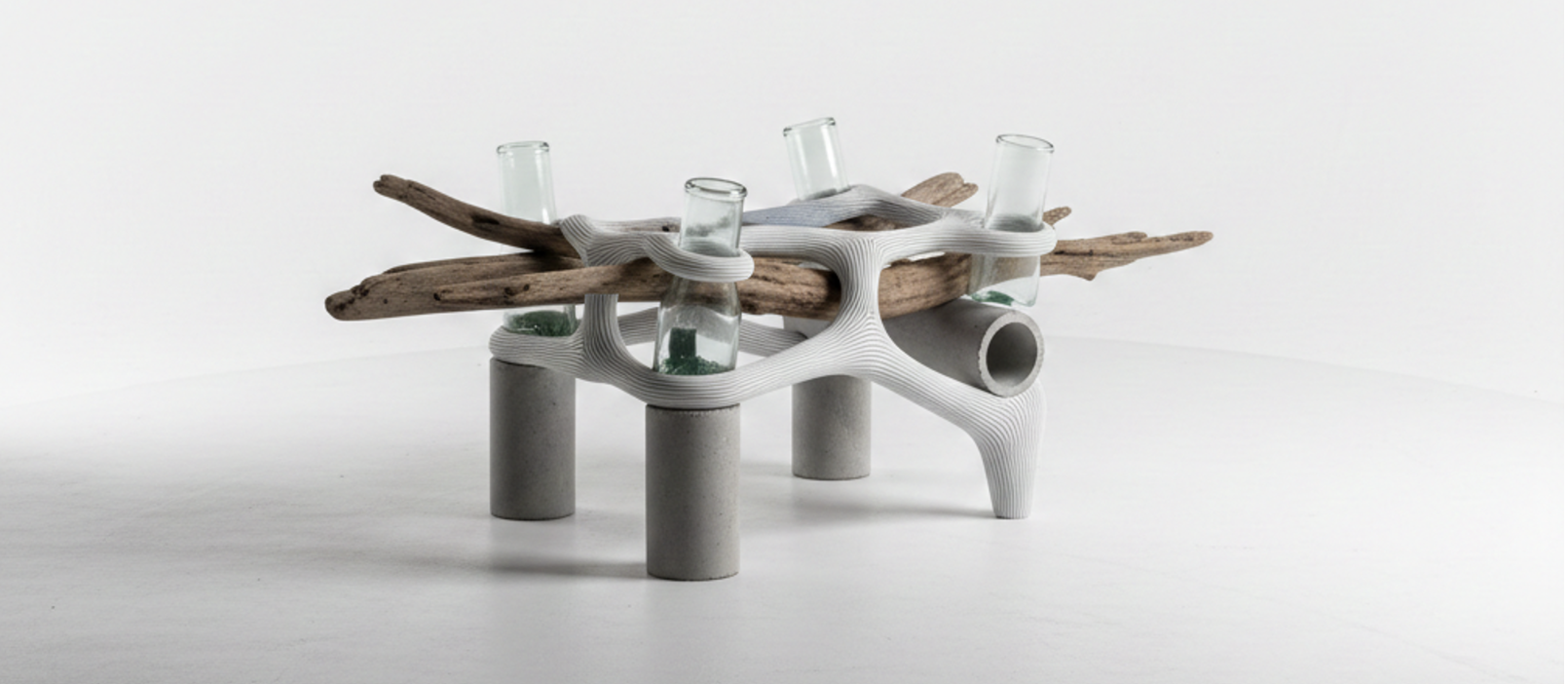
The seminar explores digital fabrication and computational design applied to repurposed objects. Students will document and scan found objects, develop parametric models to adapt and connect them, and use 3D printing throughout the semester for early prototypes, iterative testing, and final assemblies. The course emphasizes hands-on experimentation, iterative design, and integration of digital and physical workflows.
Final Deliverable
1:1 functional furniture piece made primarily from repurposed objects, assembled or enhanced with 3D-printed components.
Key Topics:
- 3D Scanning & Object Cataloguing: Collecting, documenting, and preparing scanned objects for digital modeling.
- Parametric Thinking & Design (Grasshopper3D): Creating rule-based, adaptable workflows to connect and modify objects.
- Mesh Theory & Modeling (Dendro): Understanding mesh structures, volumetric modeling, and connector design.
- Mesh-Based Structural Performance: Exploring local structural optimization and performance feedback using computational tools.
- 3D Printing & Prototyping: Iterative fabrication for testing, assembly, and adaptation of components.
- Collaborative & Individual Design: Working individually and in teams, focusing on experimentation, iteration, and documentation.
Methods:
The course combines short lectures, digital tool tutorials, and hands-on fabrication sessions. Students work individually and collaboratively, focusing on digital-physical integration and iterative prototyping. Early failures are expected and treated as part of the learning process.