Back
BackLiving Materials in Simulated Microgravity
Integrative Design / EXTREMES has joined a new research collaboration with Wrocław University of Science and Technology (WUST), led by Dr. Anna Jurga, studying how living materials and biological systems behave under simulated microgravity, and how they might function within bioregenerative life-support systems and extraterrestrial habitats.
The project
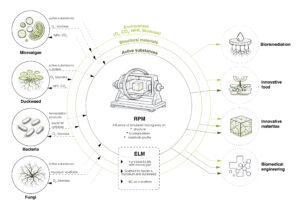
WUST is establishing a ground-based microgravity simulation facility built around a Random Positioning Machine (RPM) with an accompanying set of measurement probes. The RPM continuously reorients samples so that, time-averaged, gravity has no preferred direction, allowing long-duration biological experiments without access to orbit.
Four biological systems will be studied, each selected for a distinct and complementary function:
- Microalgae – photosynthetic microorganisms cultivated in suspension: oxygen production, CO₂ capture, uptake of nitrogen and phosphorus, and nutritionally valuable biomass.
- Duckweed (Lemna) – a floating aquatic plant performing the same photosynthetic functions at macroscopic scale, contributing to water purification and biomass production.
- Cellulose-producing bacteria – bacterial cellulose as a structural matrix for Engineered Living Materials (ELMs).
- Fungi – mycelium as the basis for functional composite materials.
The work targets processes relevant to environmental engineering and life support: water and air purification, oxygen production, CO₂ capture, nutrient cycling and biomass utilisation, alongside material biofabrication.
Partners and our role
The project is led by WUST, where the team draws on two departments, Environmental Engineering and Chemistry. Together with our background in architecture and design research, and the materials expertise of Dr Ignazio Roppolo’s group at Politecnico di Torino, the consortium spans a very interdisciplinary range.
Our contribution centres on bacterial cellulose. We are developing a bioreactor for submerged, three-dimensional bacterial cellulose growth, designed to make liquid-culture cultivation testable under simulated microgravity: how the material grows and forms without gravitational settling, what shapes it takes, at what rate it develops, and how those parameters can be fine-tuned. The work forms part of Dr Brandić Lipińska’s ongoing research, Resource-Driven Bio-Manufacturing: Integrative Strategies for Living Architecture in Extreme Environments.
Kick-off in Innsbruck
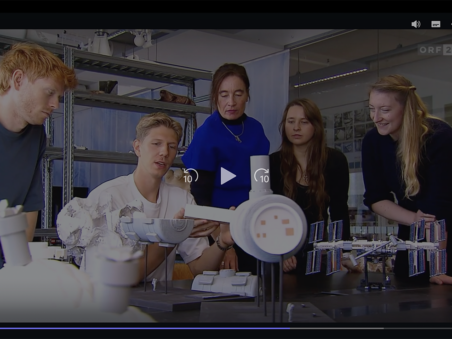
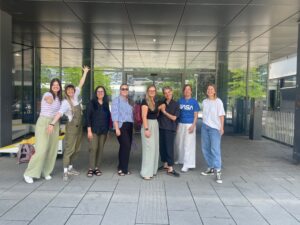
The WUST team visited the University of Innsbruck at the end of June for a research visit marking the project’s kick-off. Alongside setting the workplan, the visit allowed for in-person brainstorming of new ideas and collaborative research directions bridging living materials, environmental engineering and space architecture.
Link to the project announcement: