Back
BackReCoDeFab
ReCoDeFab – Computational Design & Fabrication for Circularity
Computational methods for circular design, using digital tools and found materials.
This seminar investigates how computational design and additive manufacturing can support circular, resource-conscious design strategies. Students will explore the integration of 3D-scanned found objects, parametric modelling, and 3D printing to develop ecologically aware design approaches. By the end of the semester, they will present a small-scale design prototype demonstrating a meaningful use of digital fabrication.
Key Topics:
- Local ecological challenges: biodiversity, resilience, and climate (incl. lecture by Marion Chatelain, Zoology Dept., Prof. Michael Traugott)
- 3D Scanning & Object Collection: digital cataloguing of found objects as design inputs
- Parametric Design & Simulation: custom workflows for adaptive, rule-based design using reused materials
- Prototyping & Fabrication: structural testing and performance-focused 3D printing
- Collaborative Design: individual and group proposals with applications in conservation and circular design
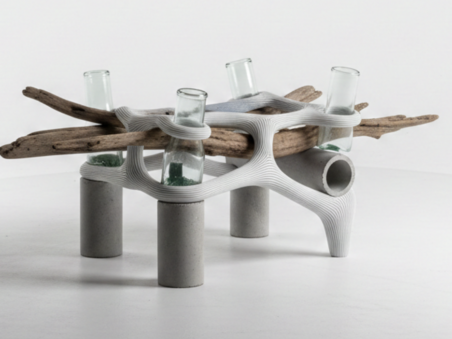
Photo © Architecture Biennale Venezia 2025, Domino 3.0 / Generated Living Structure, AI: Prof. Yutaka Matsuo (The University of Tokyo), Structure: Prof. Norihiro Ejiri (Japan Women’s University), photo: Barbara Imhof