Back
BackThe water will stay
New York 2140 and the Architecture of Another City
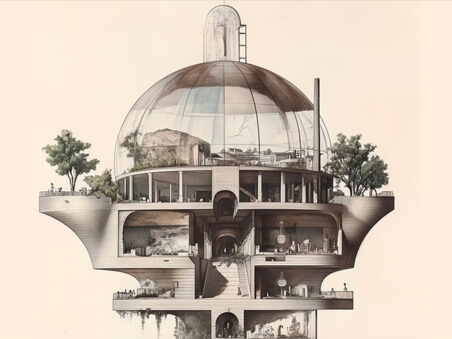
This master’s studio examines architecture under the conditions of an irreversibly changed climate. Its point of departure is Kim Stanley Robinson’s novel New York 2140, which imagines a future in which sea levels have permanently risen and large parts of New York are flooded. Streets have become canals, skyscrapers islands, and ground floors sealed off or repurposed zones. The city is not abandoned, but continues to be inhabited, rebuilt, repaired, and reorganized.
The studio does not adopt this scenario as a formal model, but as a critical instrument for designing scientifically grounded futures. At its core is the question of how architecture operates in a world in which the climate crisis is no longer understood as an approaching threat, but as an everyday reality. Water is treated not as a state of exception, but as a lasting condition. Accordingly, architecture is understood not only as an object, but as a medium of adaptation, transformation, and the organization of collective life.
Robinson’s novel connects the spatial consequences of climate change with questions of property, infrastructure, social inequality, cooperation, and the commons. In this vision, the city of the future emerges not only through technical solutions, but also through new forms of living together.
The studio takes this literary world seriously, but not literally. Based on current scientific knowledge about climate, resources, ecology, energy, mobility, and social transformation, students are asked to develop their own future scenarios for the year 2140. Fiction here does not serve as illustration, but as a method of spatial research: a medium for critically, precisely, and creatively investigating possible futures through design.
Requirement:
For the first meeting on 7 October, students must prepare, based on Kim Stanley Robinson’s book New York 2140, (1) a mood board and print it in A2 format. In addition, (2) they must research three facts for the shared „Climate Atlas 2140.“ These facts may relate, for example, to sea-level rise, temperature development, heavy rainfall and storm events, energy supply, food systems, water cycles, biodiversity, population development, migration, digital platforms and governance, health, and care systems.
Possible design-related questions
- How does public space change in an amphibious city?
- What forms of housing emerge in a permanently flooded metropolis?
- How can energy, water, and material cycles become architecturally visible and spatially effective?
Literature
- Intergovernmental Panel on Climate Change (IPCC) (no date) Seventh Assessment Report, Working Group III. Available at: (Accessed: 17 July 2026).
- Columbia University Graduate School of Architecture, Planning and Preservation (no date) Course 10662-5352. Available at: (Accessed: 17 July 2026).
- Intergovernmental Panel on Climate Change (IPCC) (2023) AR6 Synthesis Report: Climate Change 2023. Geneva: IPCC.
- Intergovernmental Panel on Climate Change (IPCC) (2018) Global warming of 1.5°C. Geneva: IPCC.
- United Nations Environment Programme (UNEP) (2024) Emissions Gap Report 2024. Nairobi: UNEP.
- United Nations Environment Programme (UNEP) (2024) Adaptation Gap Report 2024. Nairobi: UNEP.
- World Meteorological Organization (WMO) (2025) State of the Global Climate 2024. Geneva: WMO.
- Friedlingstein, P. et al. (2024) Global Carbon Budget 2024. Exeter: Global Carbon Project.
- International Energy Agency (IEA) (2024) World Energy Outlook 2024. Paris: IEA.
- International Energy Agency (IEA) (2021) Net Zero by 2050: A Roadmap for the Global Energy Sector. Paris: IEA.
- Watts, N. et al. (2024) The 2024 report of the Lancet Countdown on health and climate change. London: The Lancet Countdown.
- National Centers for Environmental Information (NCEI) (2026) Monthly Climate Report: Global Annual Temperature Rankings Outlook. Asheville, NC: NOAA/NCEI.
photo credit: Wasser und Geröll: Der Times Square in New York, Foto: Marc A. Hermann / AP